
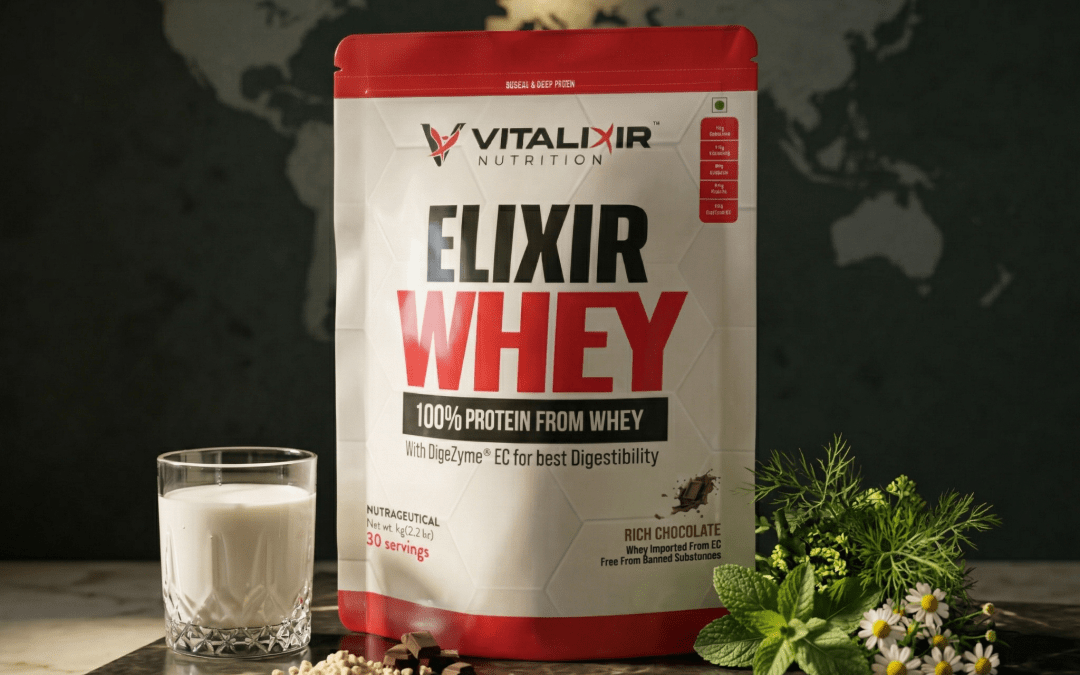
A Message That Needed to Be Said Out Loud
If you’ve recently checked the price of your Elixir Whey and noticed a change, you deserve a straight answer — not a vague “due to market conditions” line buried in fine print.
You’ve trusted us. You’ve made Elixir Whey a non-negotiable part of your daily routine. You’ve recommended it to your gym friends, your family, and your community. That trust means everything to us, and it’s precisely why we owe you complete transparency.
So here it is — the full, honest picture of why whey protein prices have risen across India and the world, what’s happening in global dairy markets, and most importantly, what has not changed at Vitalixir: your Elixir Whey, your formula, your gut-friendly scoop. Not one ingredient altered. Not a single gram compromised.
Let’s break it all down.
What Is Happening to Whey Protein Prices Globally?
The Short Answer
Whey protein prices have surged 50–110% between 2024 and 2025–2026. This is not hype. It is being tracked and confirmed by commodity analytics firms, dairy market analysts, and global nutrition industry observers alike.
The cause is a “perfect storm” — a term analysts have used repeatedly — where explosive, unprecedented demand has collided with structural limits in global production capacity. The result: record-high prices and critically tight supply, especially in the US and Europe, the two regions that supply the highest-quality whey protein to the world, including India.
The 7 Real Reasons Behind the European Whey Protein Price Surge
1. The GLP-1 Revolution Has Changed Everything
This is the single biggest driver that most people haven’t heard of — and it’s reshaping the global protein market fundamentally.
GLP-1 receptor agonist medications — brand names like Ozempic and Wegovy — have exploded in adoption. Approximately 12% of the US population now uses these medications for weight management. Here’s the problem they create for the whey market: studies show that people on GLP-1 drugs can lose 25–40% of their total body weight as lean muscle mass, not just fat. To prevent this, physicians and dietitians are actively prescribing high-protein diets — and whey protein, particularly whey protein isolate (WPI), is the gold standard recommendation due to its complete amino acid profile and fast absorption.
This means tens of millions of people who were never supplement consumers before are now buying whey protein on medical advice. The global demand curve has shifted in a way the supply chain was simply never built to handle.
The India connection: GLP-1 drug patents on semaglutide — the active compound in Ozempic — are expiring in India, China, Brazil, and Turkey in 2026. When affordable generics flood these markets, demand for whey protein in India alone could increase dramatically. The global market is already pricing this in.
2. US Whey Supply Has Essentially Dried Up — And Europe Is Absorbing the Pressure
US whey protein concentrate (WPC80) and whey protein isolate (WPI) have become virtually unavailable for new buyers in meaningful volumes. Major US manufacturers have sold their production forward well into 2026, leaving no spot-market inventory. WPI prices in the US hit $11 per pound — levels the market had never seen before.
This triggered a global scramble. Buyers from China, Southeast Asia, and across the world who previously sourced from the US pivoted to European suppliers. This sudden surge in demand for European whey created additional pressure on European prices and supply.
European WPC80 prices climbed to €14,320 per tonne, with projections already heading towards €13,000–€14,500 per tonne for 2026 contract volumes. European WPI remained elevated at around €20,500 per tonne. When your ingredient sourcing is in Euros and the price has risen this sharply, that cost has to be reflected somewhere.
India imports the majority of its premium whey protein from Europe and the US. There is no large-scale domestic alternative. This means Indian consumers and brands alike feel the full weight of these international price shifts.
3. Processing Infrastructure Cannot Keep Up with Demand
Here’s a fact that surprises most people: the global shortage is not caused by a lack of milk. Global dairy production remains relatively stable. The problem lies downstream.
Whey protein is a byproduct of cheese manufacturing. It must be filtered, concentrated, and spray-dried into WPC or WPI — processes that require expensive, specialised membrane filtration systems and spray-drying towers. These take years and hundreds of millions of dollars to build.
Major dairy companies — including Glanbia, Tirlán (€126 million investment), and Idaho Milk Products ($200 million investment) — are actively building new capacity. But none of these expansions will deliver meaningful new supply until late 2026 or 2027 at the earliest. The demand wave arrived before the infrastructure was ready. That gap is the shortage.
4. Global Supply Chain Costs Have Not Normalised
International shipping costs, port handling fees, fuel surcharges, and logistics delays — all of which spiked during 2021–2022 — have not returned to pre-pandemic levels. For a product like whey protein that travels from European dairy facilities to Indian warehouses, every step in that chain carries a cost.
Add to this the impact of geopolitical tensions affecting shipping routes and trade flows, and you have a logistics cost structure that is structurally higher than it was three years ago. These costs are baked into every tonne of protein imported into India.
5. Rising Dairy Farm Costs — Feed, Labour, Energy, Climate
Dairy farms in Europe — the primary source of high-quality whey — have faced compounding cost pressures:
- Feed costs for cattle have remained elevated due to global grain price pressures
- Energy costs for farm operations and dairy processing facilities have risen significantly, particularly in Europe following the 2022 energy crisis
- Labour shortages have affected both farm operations and processing plants
- Climate stress: Record-breaking heatwaves across major dairy-producing regions have led to a reduction in milk protein density. When cows experience heat stress, the protein content of their milk declines — meaning more raw milk is required to produce each kilogram of whey protein isolate. This raises the cost per gram at the source
Stricter European environmental regulations have also increased compliance costs for dairy operations, and these are passed through the supply chain.
6. India’s Import Duties and Currency Pressures
India does not produce sufficient high-quality whey protein domestically to meet consumer demand. This means we are almost entirely reliant on imports, and importing comes with its own cost layers:
- Customs duties and GST on imported whey protein
- INR/EUR and INR/USD exchange rate fluctuations — when the Rupee weakens against the Euro or Dollar, import costs rise proportionally
- Freight insurance and customs clearance expenses
These are structural realities of the Indian nutrition supplement market that every brand importing European whey must navigate.
7. Explosive Growth in Global and Indian Protein Demand
India’s protein supplement market is growing at an estimated 11% CAGR — among the fastest in the world — driven by rising fitness awareness, gym culture, social media influence, and a growing recognition of India’s widespread protein deficiency. The Indian whey protein market alone is projected to grow from approximately $185 million in 2025 to over $248 million by 2034.
This growing domestic demand, combined with the global surge described above, means the supply-demand equation has fundamentally tipped. The days of “commodity-priced” premium whey are, at least for now, behind us.
Why a Suspiciously Cheap Whey Protein Should Worry You More Than a Price Increase
This needs to be said plainly.
When global raw material costs for WPI have hit $11 per pound and European WPC80 is at €14,320 per tonne, a protein product priced significantly below market rates is telling you something important — either about what’s actually in it, or about how the formula has been quietly changed.
Some brands, when faced with rising input costs, have:
- Replaced isolate with cheaper concentrate without clear disclosure
- Reduced actual protein yield per serving while keeping serving size the same
- Added fillers, maltodextrin, and inferior amino acid blends to inflate label numbers
- Switched from European-sourced whey to lower-quality alternatives with less stringent standards
These are the kinds of changes that harm your results and your health — and they often go unnoticed because they’re made quietly.
We didn’t do any of that.
What Has NOT Changed at Vitalixir: Our Promise on Elixir Whey
This is the most important part of everything we’re saying today.
Every ingredient in Elixir Whey is identical to what it has always been. The formulation has not been altered. Not a single element changed.
Our gut-friendly Elixir Whey remains:
✅ Same European whey source — premium quality, same origin, same standard ✅ Same protein yield per serving — every gram of protein you expect, delivered exactly as before ✅ Same digestive enzyme blend — because gut comfort is the whole point of Elixir ✅ Same amino acid profile — complete, bioavailable, effective ✅ Same clean label commitment — no hidden fillers, no formula padding, no shortcuts ✅ Same gut-friendly formulation — low lactose, easy on the stomach, crafted for Indian digestive sensitivities ✅ Same taste, same texture, same mixability — your daily ritual, unchanged
The only thing that has changed is the price — and only because the cost of maintaining this standard has risen.
We will not dilute what makes Elixir Whey what it is just to keep a number on a label looking comfortable. The integrity of the product comes first. That is not a marketing statement. It is the reason we built Vitalixir.
Frequently Asked Questions (FAQ)
Q: Why has the price of Elixir Whey increased? A: The price increase is driven by a global shortage of European whey protein, record-high raw material costs caused by surging GLP-1 medication-driven demand, US supply constraints pushing buyers to Europe, rising dairy farm and logistics costs, and INR import pressures. These are market-wide factors affecting every brand that sources premium European whey.
Q: Has the Elixir Whey formula changed? A: No. Every ingredient, every quantity, every aspect of the formulation remains exactly the same. The gut-friendly enzyme blend, the protein source, the amino acid profile — all unchanged.
Q: Is this price increase permanent? A: Industry analysts expect meaningful supply relief as new processing infrastructure — including major investments by Glanbia, Tirlán, and Idaho Milk Products — comes online from late 2026 onwards. However, the long-term baseline for premium whey is likely to be higher than pre-2024 levels.
Q: Why should I trust that the quality hasn’t changed? A: We are telling you openly and in writing. We are not hiding behind vague language. Our sourcing, our third-party testing, our formulation integrity — these are commitments we are making publicly. If that ever changes, you will hear it from us directly.
Q: Is Elixir Whey still gut-friendly? A: Absolutely. The digestive enzyme blend that makes Elixir Whey gentle on Indian stomachs has not been altered. The gut-friendly character of Elixir Whey is non-negotiable at Vitalixir.
Q: Are other whey protein brands in India also increasing prices? A: Yes. Any brand that sources genuine European or US-origin premium whey is facing the same raw material cost reality. Brands that have not raised prices may have quietly changed their formulation or switched to lower-quality sources — which is worth investigating carefully.
Q: What is WPC80 and WPI and why does their price affect my protein? A: WPC80 (whey protein concentrate at 80% protein) and WPI (whey protein isolate at 90%+ protein) are the two primary forms used in premium protein supplements. These are the globally traded commodities whose prices have risen sharply. Elixir Whey uses premium-grade whey, which directly tracks these market prices.
A Note on What “Gut Friendly” Really Means — And Why We’ll Never Compromise It
India’s protein supplement market has a problem: most whey products are not designed with Indian digestive physiology in mind. High lactose content, heavy milk-based bases, and lack of digestive enzymes mean that many people experience bloating, gas, and discomfort — and end up blaming protein itself.
Elixir Whey was built to solve that. The gut-friendly positioning is not a marketing phrase — it is an engineering decision reflected in the formulation. Low lactose. EU approved Digestive enzyme inclusion. Clean processing. Ingredients selected for bio-availability and tolerance.
These choices make the product more expensive to produce. They also make it more expensive to maintain those choices when raw material costs rise. We have made the decision to absorb where we can and pass through only what is unavoidable — rather than compromise the product.
Your gut will still thank you. We’ve made sure of it.
To Our Community: Thank You
We know that any price increase is a frustration. We know some of you budget carefully for your supplements. We know that the fitness journey is demanding enough without added financial pressure.
We see you. We hear you.
What we also know is that you’ve chosen Elixir Whey because it works for you, because it feels right in your body, and because you trust what’s in it. That trust is something we carry with us every single day when we make sourcing decisions, formulation decisions, and pricing decisions.
We don’t take shortcuts with your health. We didn’t when raw material prices were manageable. We won’t now that they’re not.
Thank you for being part of the Vitalixir community. Thank you for understanding the complexity of the situation. Thank you for continuing to make Elixir Whey your protein of choice.
We’re not just a brand. We’re a standard. And we’re holding it.
— The Vitalixir Nutrition Team
This blog post is for informational transparency. Pricing on all Vitalixir products is available on our official website and authorised retail channels.